Feeds:
Posts
Comments

Posts Tagged ‘Wikipedia’

Wikipedia defines DROODLES:  The trademarked name “Droodle” is a nonsense word suggesting “doodle”, “drawing” and “riddle.” Their general form is minimal: a square box containing a few abstract pictorial elements with a caption (or several) giving a humorous explanation of the picture’s subject. 

Droodles are (or were) purely a form of entertainment like any other nonsense cartoon and appeared in pretty much the same places (newspapers, paperback collections, bathroom walls) during their heyday in the 1950s and 1960s

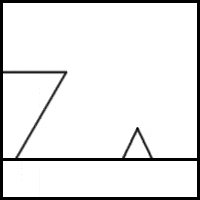
The following definition is in the book, DROODLES by Roger Price:  A Droodle is a borkley looking sort of drawing that doesn’t make any sense until you know the correct title.  For instance, here are some classic Drooles.

This is a clever Droodle or something from the mind of a crazy person! What do you think this is a picture of???  Please post your answer in comments.  Answer tomorrow!

Photo from Droodles by Roger Price

Photo from Droodles by Roger Price

This is NOT Two Palm Trees on a Dessert Island

This is NOT Two Palm Trees on a Dessert Island

See in the second Droodle I have helped you discern the subject by telling you what it is NOT!

Read Full Post »

50% Off - Magic Words

50% Off – Magic Words

My first introduction to Boxing Day came way back in the ’80’s when our next-door neighbor at the time, invited us to their house the day after Christmas and told us to bring a gift we had previously received-more than likely one that was not well-received by us.  In other words that tasteless ashtray your Aunt gave you or the unwelcome set of beer mugs each with one of the Seven Dwarfs depicted.  We had such a great time, so many laughs….but then they told us the real idea behind Boxing Day and it went something like this.

The exact etymology of the term “boxing” is unclear. There are several competing theories, none of which is definitive.[1] The European tradition, which has long included giving money and other gifts to those who were needy and in service positions, has been dated to the Middle Ages, but the exact origin is unknown. It may come from a custom in the late Roman/early Christian era, wherein metal boxes placed outside churches were used to collect special offerings tied to the Feast of Saint Stephen,[2] which in the Western Church falls on the same day as Boxing Day.
In Britain, it was a custom for tradesmen to collect “Christmas boxes” of money or presents on the first weekday after Christmas as thanks for good service throughout the year.[3] This is mentioned in Samuel Pepys’ diary entry for 19 December 1663.[4] This custom is linked to an older English tradition: Since they would have to wait on their masters on Christmas Day, the servants of the wealthy were allowed the next day to visit their families. The employers would give each servant a box to take home containing gifts and bonuses, and sometimes leftover food.  Source: Wikipedia

In the United States, somehow along the way, Boxing Day has taken on a double meaning.  It seems to be THE day to return BOXES – those presents which neither fit our taste or our bodies.  LONG lines of over-dressed and over-heated customers stand in line to endure the ordeal of returning unwanted or unwelcome items.

Secondly, Boxing Day is a day to rush to the stores and buy MORE items, those many things that are now deeply-discounted.  We are truly a nation of consumers!  As for me, as soon as I finish this blog I’m off to find next year’s Christmas cards, wrapping paper and anything else I somehow found out I can’t live without especially now that is marked 50% off!

What are you doing this Boxing Day?

Read Full Post »

Double entendre postcard. "All right boss...

Image via Wikipedia

Wikipedia defines a paprosdokians as ” a figure of speech in which the latter part of a sentence or phrase is surprising or unexpected in a way that causes the reader or listener to reframe or reinterpret the first part. It is frequently used for humorous or dramatic effect, sometimes producing an anticlimax. For this reason, it is extremely popular among comedians and satirists.[1]

Some paraprosdokians not only change the meaning of an early phrase, but they also play on the double meaning of a particular word, creating a form of syllepsis. “  Gail sent me an email of these clever phrases and I want to share some of them with you in this Thursday’s Top Ten.

  1. Where there’s a will, I want to be in it.
  2. If I agreed with you, then we’d both be wrong.
  3. The last thing in the world I’d want to do is hurt you.  But it’s still on my list.
  4. Knowledge is knowing that a tomato is a fruit.  Intelligence is knowing not to put in the fruit bowl.
  5. I thought I wanted a career.  Turns out I only wanted a paycheck.
  6. I didn’t say it was your fault.  I said I was blaming you.
  7. You don’t need a parachute to sky dive.  You only need a parachute to sky dive twice.
  8. I used to be indecisive.  Now, I’m not so sure.
  9. They begin the evening news with “Good Evening” and then proceed to tell you why it isn’t.
  10. To steal ideas from one person is plagiarism, but steal from many and it’s called research.

Read Full Post »

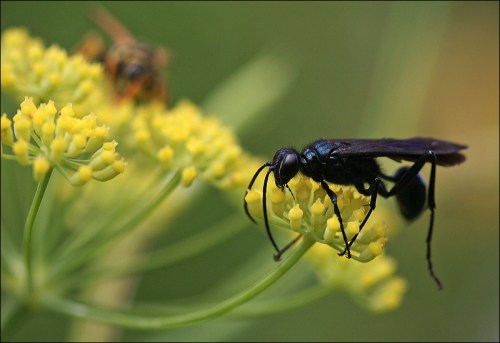
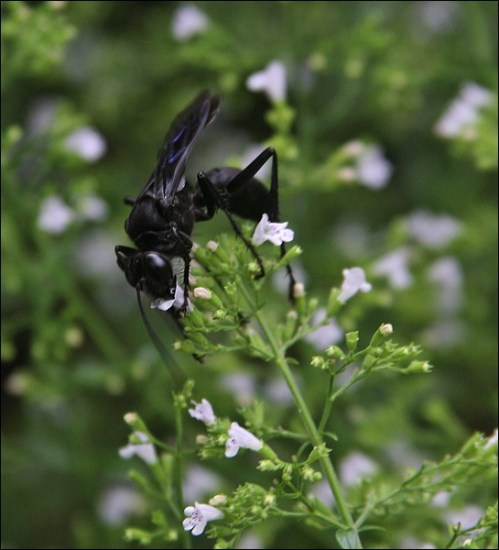
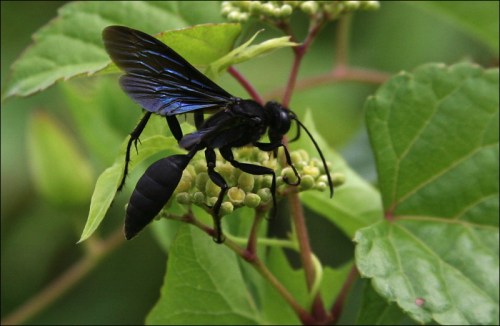
Well not really because he isn’t even black after all.  The little creature in question is actually a purple blue iridescent.  Murray has been out and about and ventured to Roosevelt Island which really is an island off the island of Manhattan.  He came across some great gardens and took fabulous photos of yellow jackets, flowers, bees, hornets and wasps.  Today we are all about the Great Black Wasp aka Sphex Pensylvanicus.

The great black wasp lives across most of North America, the larvae feed on living insects that the female paralyzes and brings to the underground nest.  Wicked huh? Why is always the female that does the dirty work and makes sure everyone is fed??  The following is from Wikipedia:

Adult females of S. pensylvanicus build an underground nest which they provision with various orthopteran insects,[6] particularly of the genera Microcentrum, Amblycorypha and Scudderia.[3] Prey are stung three times, once in the neck and twice in the thorax, and are paralyzed by the wasp’s sting, although they can survive for weeks.[1] The prey are then carried to the nest. While collecting their prey, the females are vulnerable to kleptoparasitism, in which birds, including the house sparrow (Passer domesticus) and the gray catbird (Dumetella carolinensis), steal the prey that the wasp has collected.[6]

As you can see, Mother Nature has provided a food chain for all God’s little creatures – I wonder who eats the wasp?

great black wasp, sphex pensylvanicus

LOOK at this tiny little creature!!!!

Roosevelt Island, sphex pensylvanicus, great black wasp

"Pollinating is my life"

sphex pensylvanicus, great black wasp

Hanging On With One Leg

great black wasp

Look closely to see the wasp in action

sphex pensylvanicus

Great profile!

great black wasp

"And now a little from this flower"

The Great Black Wasp

All photos are courtesy of Murray Head

Read Full Post »